Introduction
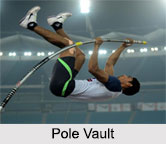 Pole Vault is a popular field event and track event in India, where the participant uses long and flexible pole (today it is generally made of carbon fibre or fibreglass) as a help to leap over a bar. Now it is popular game in Indian athletics.
Terminology in Pole Vault
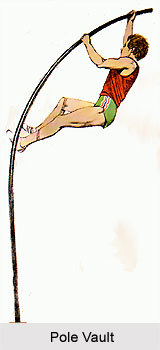 Terminology in pole vault is an important aspect that adds dimension to the game. Some of the important terms that have been added to the game are as follows:
Bar: This refers to the cross bar that is suspended above the ground by the standards.
Box: This is actually a trapezoidal indentation in the ground with fibreglass or metal covering at the end of runway in which vaulters "plant" their pole. The back wall of the box is closely vertical and is nearly 8 inches in depth. Until it is level with the runway, the bottom of the box, slowly slopes upward approximately 3 feet. The covering present in the box actually ensures the pole will slide to the back of the box without catching on anything. The covering`s lips partly cover onto the runaway and also ensures a smooth and thorough transition from all weather surfaces so a pole being planted does not catch on the box.
Drive Knee: In the pole vault event, during the phase of the plant, the knee is actually driven forward at the time of "takeoff" to actually help propel the vaulter upward.
Grip: This is the vital during the game, and is the case where vaulter`s top hand is on the pole. With the improvement of the vaulter, his grip moves up the pole incrementally. The other hand is characteristically placed shoulder-width down from the top hand. Hands are actually not allowed to grip the very top of the pole (their hand perpendicular to the pole) for safety reasons.
Jump Foot: This is also known as take-off foot. It is actually the foot that vaulter uses to leave the ground as he begins his vault.
Pit: The mats used for landing in pole vault.
Plant Position: This is the position where a vaulter with the pole reaches the back of the box and the vaulter begins his vault. His arms are fully extended and his drive knee begins to come up as he jumps.
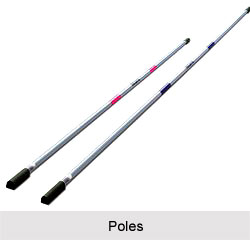
Pole: The fibreglass implement used, actually assists the vaulters up and over the bar. One side is kept stiff than the other in order to ensure that the bending of the pole after the plant. In order to determine which side of the pole is tiff, the vaulter may rest the pole on his arm and this may help him to gauge the stiff of the pole.
Standards: The equipment that holds the bar at a particular height above the ground. Standards may be adjusted to raise and lower the bar and also to adjust the horizontal position of the bar.
Steps: As the box is in static position, the vaulters must also need to adjust their approach accordingly in order to make sure they are in proper position when attempting the vault.
Swing Leg or Trail Leg: The trail leg or the swing leg is also the jump foot. After the vaulter has actually left the ground, the leg that was touching the ground last stays extended and swings forward to assist propel the vaulter upwards.
Volzing: This is a method of pushing or holding, the bar back onto the pegs while jumping over a height. Though, this now not in the rule book of pole vault anymore but this method actually needs huge amount of skills.
History of Pole Vault
History of Pole Vault defines its advent from Netherlands. In the previous era, the poles were helpful in passing over natural obstacles in marshy provinces like Netherlands, Huntingdonshire, Lincolnshire and Cambridgeshire. From the early human civilization, the draining system of these marshes created a network of canals or open drains intersecting each other to pass the water. To cross these, pole were used to jump over, which was kept at houses.
Technique of Pole Vault
 Technique in pole vault is extremely important. Use of proper technique actually helps a vaulter to clear the crossbar successfully. While in this form of the game physical agility and fitness is of utmost important, knowledge of proper technique is also very crucial. There are, in practise, many techniques that are used by the vaulters at various skill levels to clear the bar, the generally accepted technical model can be broken down into several phases, listed and described below.
The Approach : The approach of the pole vaulter is of great importance and during the process the athlete sprints down the runway in manner as to achieve correct position and maximum speed to initiate take off at the end of approach. Top notch pole vaulters use approaches with 18 to 22 strides. At the initial part of the approach the pole is generally carried upright to some degree and slowly lowered as the vaulters get close to the landing pit. This is the way athlete lessens the levered weight of the pole. The faster the athlete can run, better is his chance for the take off. It is a common point for all vaulters to slowly increase the speed throughout the approach, reaching maximum speed at take-off. Vaulters increase stride frequency while keeping the knees up like sprinter. Much unlike the short sprint events- 100 m where, the athlete runs with a much upright torso position right throughout the approach to counter balance the effect of carrying the pole.
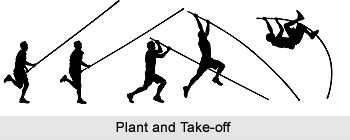
The Plant and Take-off : Plant and take off, kick-started by classic three steps out from the final step. Vaulters mainly count their steps backwards from initial point to the box only counting the steps taken on the left foot (vice-versa for left-handers) except for the second step from the box, which is taken by the right foot.
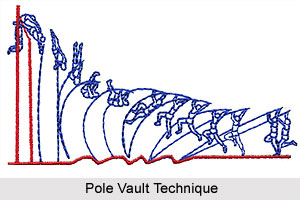
The main aim of this phase is to correctly translate kinetic energy accumulated from approach into potential energy stored by the elasticity of the pole, and to gain as much initial vertical height as possible by jumping off the ground. This process starts with vaulter raising his arms up from around the hips or mid-torso until they are fully outstretched above his head, with the right arm extended directly above the head and the left arm extended perpendicular to the pole (vice-versa for left-handed vaulters).
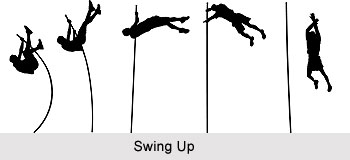
The Swing Up : This process consists of vaulter swinging his trail leg forward and rowing the pole, bringing his top arm down to the hips, while trying to keep the trail leg straight to store more potential energy into the pole, the rowing motion also keeps the pole bent for a longer period of time for the vaulter to get into optimum position. Once in a "U" shape the left arm hugs the pole tight to efficiently use the recoil within the pole. The goal is to carry out these motions as thoroughly and as quickly as possible; it is a race against the unbending of the pole. Effectively, this causes a double pendulum motion, with the top of the pole moving forward and pivoting from the box, while the vaulter acts as a second pendulum pivoting from the right hand.
The Extension : This refers to the extension of the hips upward with the outstretched legs as the shoulders drive down causing the vaulters to be positioned upside down. This position is known as the inversion. During the execution of this phase, the pole begins to recoil, propelling the vaulters quickly upward. The hands of the vaulter remain close to his body as they move from the shins back to the region around the hips and upper torso.
The Turn : The turn is immediately executed after or even during the end of the rockback. As per the name signifies, the vaulters turn 180 degree toward the pole while extending the arms down past the shoulder and head. Characteristically the vaulter will begin to angle his body toward the bar as the turn is carried forward, although preferably the vaulter will remain as straight as possible.
The Fly-Away : This is very often emphasized by novice vaulters and spectators. But it happens to be the easiest form of the vault, and a result of perfect execution of previous phases. This main generally consists of vaulter pushing off the pole and then releasing it so it falls away from the bar and mats. As the athlete goes over the then around the bar, the athlete is facing the bar. There is a natural rotation of the body over the bar. And the main concern of the vaulter is to make sure that his/her face, arms and any other appendages do not knock the bar off as he/she goes over. The vaulter should land near the middle of the foam landing mats, or pits, face up.
Modern Pole Vault
Modern Pole Vault has the complete form in the international games and sports. In the modern day, an athlete competes in pole vault as a type of jumping in track event and field event. As pole vault and high jump are both a part of jumping event the rules of the competition are more or less similar. Before the start of the competition, athlete can choose the height that they want to enter the competition with. The athletes have three attempts to clear the height. An athlete needs to proceed to the next level once he clears the height, where he will get three more attempts. But if the vaulter faces three consecutive misses then he is out of the competition. To play, one needs to follow and study the techniques and terminology of pole vault.
Choosing the Pass Heights
Before the beginning of the game, athlete can choose the pass height. If he or she failed in the first attempt, then he or she can pass to the next height. Only two attempts are provided. They need to achieve the three consecutive misses. If they earn the two misses, they can put to the next level. 
Clearing the Highest Height
The athlete after clearing the highest height is noted as the "winner". If the two competent have the same height then a tie breaker is held to find a winner. If the vaulters, who are in tie breakers, have the same number of misses, then the tie is broken by the total number of misses in the competition.
Jump Off
A Jump off is required to break a tie. It is a kind of long jump. The marks achieved in this type of jump-off are considered valid. If in other places, the tie still exists, a jump off is conducted normally, until and unless of course the competition is a qualifying meet, and the tie exists in the final qualifying spot.
Administrative Jump Off : Administrative Jump off is needed in order to break the tie. But, here, the marks are not measured valid for any other purpose than breaking the tie. A jump off is known as a sudden death opposition, in which the tied vaulters attempt the same height, starting with the last attempted height. The bar goes down by a small rise, if it is missed. If both levels are cleared, then the bar goes up by a small increment. Each vaulter will get only one attempt at each height until one makes and one misses.
Foul Attempt
Foul Attempt is happened when the pole is dislodged from the bar (uprights). A foul attempt is also ruled, even if the athlete themselves has cleared the height. An athlete does not get benefit from quickly leaving the landing pad before the bar has fallen.
Exception of the Foul Attempt : The exception of foul attempt is if the vaulter is vaulting outdoors and has made a clear effort to throw the pole back, but the wind has blown the pole into the bar; this counts as a clearance. This call is given by the fair judgment of pole vault officials. If the pole breaks during the jump of an athlete, it is considered an "Equipment Failure". Then this "Equipment Failure" is ruled as "Non-jump".
Indian Pole Vaulters
Pole Vault is not a popular game in India. But by the successive attempts of some of the Indian pole vaulters who set the records, this game is gaining popularity. V. S. Surekha holds the current national record of 4.15 m set at National Open Championships held at New Delhi in 2014. Karamjit Kaur of Punjab cleared a height of 3.15m on the concluding day of the Federation Cup Senior Athletic Meet. It is popular athletic meet in India. Dhirendra Kumar of Gujarat met the record in the Boys Pole Vault category on 13th National Youth (Under 18) Athletics championship.