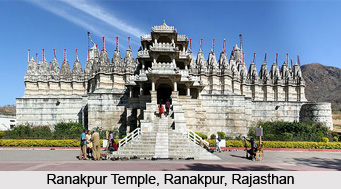
Temples of Ranakpur are popular throughout the world for their magnificent architectural patterns and are significant
pilgrimage spots for the
Jains, located in
Ranakpur village, near Sadri town,
Pali District,
Rajasthan. They are based at a distance of nearly 95 kms from the northern portion of
Udaipur and were constructed during the 15th century, immensely reputed for their gigantic size. The joint efforts of a Jain businessman named Seth Dharna Sah as well as
Rana Kumbha, the ruler of
Mewar in 15th century was responsible for the creation of this ancient temple. Ranakpur Temples were so named in the honour of this royal monarch and even the village of Ranakpur was named to commemorate him. Present in the western part of the
Aravalli Mountain Ranges, Ranakpur Temples had been erected out of light shaded marble and occupied an area measuring 48, 000 square feet, comprising 1, 400 beautifully carved pillars. The temple is dedicated to Adinatha.
 History of Ranakpur Temples
Construction of Temples of Ranakpur commenced during 1437 CE as per the inscriptions of a
copper plate and also a
Sanskrit text termed as `
Soma-Saubhagya Kavya`. Deepaka was the chief architect who had supervised the erection of this temple. An
inscription engraved on a pillar reveals that an architect named Deepaka had been instrumental for overseeing the creation of the temple during 1439 at a special direction of `Dharanka` who was a devoted Jain. Following the completion of the ground floor of the temple, the religious ceremonies were conducted by Acharya Soma Sundar Suri of Tapa Gachha according to Soma Saubhagya Kavya. Finally, the construction was finished in 1458 AD. However, renovations were performed at the temple at regular intervals. The creation of `mandapas` and `devakulikas` was financed by certain influential families. During the olden days, Anandji Kalyanji Pedhi had managed the temple trust.
Architecture of Ranakpur Temples
Surya Temple,
Chaumukha Temple,
Amba Mata Temple and
Parsavanath Temple are the different temples which are existent in the premises of Ranakpur Temples. Chaumukha Temple is said to be the most important temple and it is four-faced, true to its name, `Chau Mukha`. Adinatha, who was the first
Jain Tirthankara is the presiding deity of Ranakpur Temples. Visitors will come across four separate doorways to be granted access into the temples. The Chaumukha temple faces four different directions which signify the four cardinal directions of the conquest of Adinatha, the Jain Tirthankara.
Distinctive turrets, cupolas, `shikhara` and domes characterises the architectural features of Ranakpur Temples, which is seen rising over the hill-slopes of Aravalli Hills. Each of the pillars sport a unique appearance and no two pillars are similar. The statues of the temple face towards one another. One will observe a spectacular carving which has been made from a single piece of rock, at a point where 108 heads of various snakes and tails meet. It is impossible to seek the end of the tails. The largest image of the temple is based on the western portion of the temple near the axis of the main temple.
Tiny shrines and temples surround the Ranakpur Temples which possess separate terraces and domes. Five temple spires are witnessed rising above the walls and 20 cupolas rise from the temple roofs. The largest shrine is home to the central altar of the temple and elaborate foliate scrollwork and attractive geometric motifs adorn the ceilings of Ranakpur Temples. The temple grounds comprise four other shrines which consist of 80 domes, 400 columns and 24 pillared halls. Brackets embellished with the images of deities exist in the lower and also upper portions of the temple domes. One of the most striking architectural features of the Ranakpur Temples is the depiction of 45-feet embedded celestial nymphs playing the
flute in several
dance postures. One would be amazed to learn that these temple columns alter their colour to a pale blue from golden hues every hour.
Harmonious sounds are produced by the two giant
bells which measure about 108 kg and are present in the prayer hall of the temple which is referred to as the `mandap`. The Chaumukha Temple stands majestically, similar to a heavenly aircraft or a `Nalinigulm
Vimana`, which imparts a heavenly air to the
Jain pilgrimage centre. It took 65 years to construct the Ranakpur Temples, only due to the presence of an intricate architectural style. Parsavanath Temple is also a wonderful temple structure which is popular for its engraved windows decorated with Jain figures. `Patriyon Ka Mandir` is another name of the Parsavanath Temple. Located close to Ranakpur Temples are two other temples dedicated to `Surya Narayan` or
Lord Surya and
Neminath or the 22nd
saint. Circular architectural characteristics accompanied by wall projections are the features of the Surya Narayan Temple. Ranakpur Temple was once nominated as one of the top 77 wonders of the world; though later it was not included in that list.

 Ranakpur is located 90 kilometers northwest of Udaipur. It is also accessible from Kumbhalgrah. The main attraction here is the Ranakpur Jain Temple. Beautifully carved they date back to the 15th century. Lying in a remote valley of the Aravalli range it is one of five holiest Jain sites.