Introduction
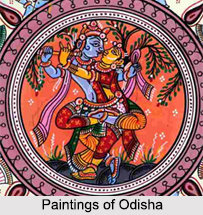 Paintings of Odisha are highly favourable in the national markets, essentially for their unique styles and attractive appearances and are available for competitive prices. Rock paintings, tribal paintings, mural paintings, `Patachitra` paintings and palm leaf paintings of Odisha are immensely popular throughout the country for their artistic excellence.
The eastern Indian state of Odisha possesses an ancient tradition of paintings which can be traced back to the prehistoric ages. Various themes and ideas have motivated the creation of these magnificent paintings.
History of Paintings in Odisha
The different forms of paintings in Odisha is believed to have originated way back in the ancient ages, which dated back to prehistoric periods which constitute the era around 300 BC to 100 AD. These beautiful paintings have been performed here in the numerous rock shelters and `mathas` belonging to this century. A majority of Odisha paintings are tribal and have been painted as part of the indigenous cultural tradition of this portion of India.
Features of Paintings in Odisha
Small geometrical and floral patterns to big animal motifs and human figures are shown hunting, fighting, dancing and doing domestic chores are the main themes along with Hindu epics. Colours used are red extracted from iron, brown from copper and white from lime compounds. Paintings are prepared with pure vegetable colours.
Folk Paintings of Odisha
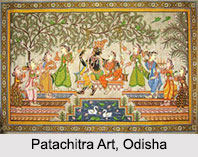 The folk paintings of Odisha are strong representatives of the state"s history and heritage in the art of painting. These paintings constitute the famed Pattachitra art done on different canvases, Palm Leaf Paintings also called Talapatachitras and Muruja art form, which is basically another manifestation of Rangoli.
Pattachitra, Folk Art of Odisha : Pattachitra art form of Odisha generally refers to traditional cloth-based scroll paintings. The subject of Pattachitra art works mostly pertain to stories of Hindu deities. Based on Hindu mythology, they are specially inspired by the Jagannath and the Vaishnava sects. The Chitrakaras of Odisha use natural colours and make these paintings in a fully traditional way. Pattachitra is one of the oldest and most popular art forms of Odisha.
Pattachitra folk art is practised by artists on cloth which they prepare themselves by coating it with a mixture of chalk and gum made from tamarind seeds, giving the surface a leather-like texture on which the artists paint with earth and stone colours. Painting is done using brushes with a mixture of clay and powder from a stone rich in iron oxide, or by incising and cutting a pattern on raw pottery using comb-like or knife-like tools.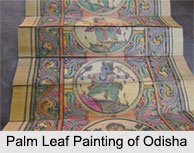 The popular theme of Pattachitra comprises legends of Lord Jagannath and His incarnation Lord Krishna. Mythological and religious folklores of Radha-Krishna, different "Vesas" of Shri Jagannath, Balabhadra and Subhadra and ten incarnations of Vishnu are important subject contents.
Palm Leaf Paintings of Odisha : Palm Leaf Paintings are the other ancient treasured arts of Odisha, also known as Tala Pattachitra and drawn on palm leaves. The process of Palm Leaf Painting involves hardening of palm leaves, sewn together thereafter to form like a canvas. The images are traced by using black or white ink to fill grooves etched on rows of equal-sized panels on palm leaves sewn together. These panels can also be easily folded like a fan and packed in a compact pile for better preservation. Often palm-leaf illustrations are more elaborated, obtained by superimposing layers that are glued together for most of the surface, but in some areas can open like small windows to reveal a second image under the first layer. The themes constitute mythological incidents, Gods and Goddesses figures, animals, flowers and trees, Radha-Krishna, Durga, Ganesha and Saraswati, natural sceneries and local folklore.
Muruja Painting in Odisha : Muruja Painting is a folk art popular in Odisha. It represents the contemporary arts of India, being basically another format of Rangoli. Muruja is drawn on the floor with multihued powders. In order to get colour powders, indigenous methods are used, such as white stones to yield white powder and charred coconut shells for black powder. These are done in religious ceremonies.
Tribal Paintings of Odisha
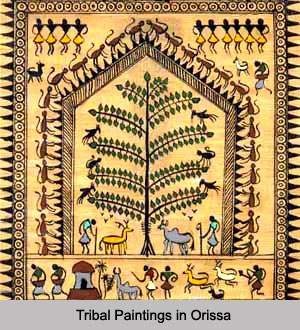 Tribal Paintings of Odisha has a prosperous tribal tradition of painting. The paintings of different communities such as Saura, Kondh, Kissans and Juang reveal the rich cultural tradition of Odisha Tribal Paintings. Thousands of master craftsmen knit magic with their hands in Odisha. The Odisha School of painting consists of tribal, folk and classical form. The classical painting, Pattachitra is painted on a specially prepared cloth which is coated with the earth to stiffen it and finally finished with lacquer after paintings, producing motifs in gorgeous colours.
History of Tribal Paintings of Odisha : The history of painting of Odisha dated back to the earliest times with rock-cover paintings, some of them are dated to the early historic period. Numerous cave paintings are tribal and rock shelter painting has continued throughout the centuries as an Oriya practice. Despite of rock painting sites, there are a number of drawings and picture resembling figures on rock exteriors at Digapahandi and Berhampur in Ganjam district and former places. Mural paintings in Odisha is in another place in India was an olden tradition and facts of mural colour coatings have been found in the caves of Khandagiri and Udayagiri dating back to the sovereignty of Emperor Kharavela who ruled in the 1st century B.C.
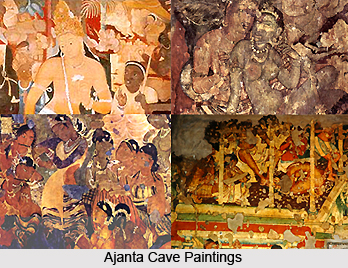
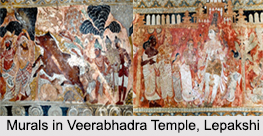
Features of Tribal Paintings of Odisha : Tribal Paintings of Odisha has some distinct features. The natures of the symbolic writings emerge to be a combination derived from Mohenjodaro and Brahmi scripts. The Ravana Chhaya Rock at Sitabinji in Keonjhar district holds a painting of very high in order, representing the "march panorama of a king riding an elephant with soldiers asset shafts and banners, pursued by a female helper". This painting carries memories of Ajanta murals. Wonderful murals decorate the inside of the Jagannath Temple, the Buddha Vijay painting in the jagamohana of the Lakshmi Temple and the Kanchi Vijay in the jagamohana of the Jagannath temple. The palm leaves have long been used as a writing material. This is exclusively local tradition of Odisha, the crafts of palm leaf manuscripts dates back to ancient times when the artists, with the help of iron pens inscribes the text or design on the surface of palm leaves, then applies a paste of tamarind seed, oil and charcoal.
Types of Tribal Paintings of Odisha
There are different types of Tribal Paintings of Odisha still existing and some of them are mentioned below:
Saura Painting: The Saura wall paintings are called italons or ikons which are drawn upon tribal myths and have ritualistic significance. Ikons make wide use of metaphorical icons which mirror the quotidian chores of the Sauras. People, horses, elephants, the sun and the moon and the tree of life are chronic motifs in these ikons. Ikons were originally painted on the walls of the Saura`s adobe huts.
Painting of Kondh Community: Wall paintings of Khonds are called `Manji Gunda". Kutia Khond paintings are very effortless and these are called Tikangkuda". Among the Kondh community, there are a variety of subgroups called Kutia Khonds and Dongria Kondhs.
Painting of Kissans: Kissans in their paintings represent samlai deity and also depict signs of agricultural movement. Tribal society Paudi Bhuyan"s paintings are called `Jhanjira". They are extra particular regarding agriculture which is reflected in a host of their paintings.
Painting of Juang: Wall paintings of Juang village contain birds, animals and flowers. Santhal community does not have paintings as such but they clean the walls and verandah of their houses with coloured mud.
Rock Paintings of Odisha
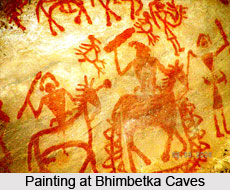
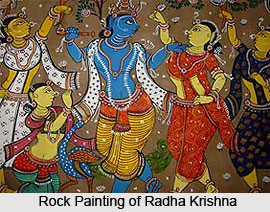 Rock paintings of Odisha are admirable masterpieces of Indian paintings created by talented artisans, which draw millions of tourists and travellers from different parts of India and also foreign visitors. Such rock paintings are existent in rock shelters present in the dense forests of western portion of Odisha. Ushakothi and Manikmada, Sundargarh District, Yogimatha and Gudahandi, Kalahandi District possesses some of the most marvellous rock paintings of this eastern Indian state. Natural rocks located here are home to prehistoric paintings. The colours employed by the painters contained pigments of iron oxides, which create colours like brown and red. Similarly, white and green colours used to be obtained from copper compounds. Such rock paintings have been done by local tribes of western Odisha and Central India.
A painting which exists at the Ravana Chhata Rock al Sitabinjhee of Keonjhar District is widely acclaimed due to its unique beauty. This painting depicts a scene wherein a ruler rides an elephant and if followed by a female attendant, soldiers and some horse riders. It bears a close resemblance to Ajanta murals which have been painted with a twig of a palm tree which has been transformed into a brush. Linear pattern is followed in these paintings. The rock paintings at Manikamada contain images of natural grandeur and figures, painted with many coats of paints. Red-orche lines have been used in the paintings at Yogimath, and generally ceilings and rear walls of rocks are painted. Horizontal patterns adorn the walls of the rocks, and designs of deer, sambhar, stag, cattle and floral or geometrical motifs are also present. Rock paintings depicting human figures contain images of humans dancing, hunting, fighting and much more. Saura tribals are known to have painted rock paintings especially in Ganjam and Koraput Districts.