Introduction
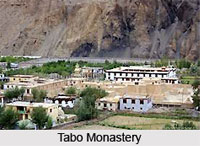 Indian monasteries are believed to be some of the most pious pilgrimages all over the world. Religious pilgrims from all parts of the globe come to visit Sarnath, near the city of Varanasi, which is a sacred monastery of the Buddhist in India. The pilgrims often stay in these monasteries as they travel to other holy places. Many of the monasteries welcome foreign visitors as paying guests. The rules of Indian monasteries are basically the same in all over India. The authorities of Indian monasteries do not allow smoking, drinking or loud music.
Buddhist Monasteries in India
The Indian states of Arunachal Pradesh, West Bengal, Sikkim, Himachal Pradesh, Karnataka and others comprise some of the most magnificent Buddhist monasteries. Bomdila Monastery and Tawang Monastery of Arunachal Pradesh, West Bengal`s Ghum Monastery, Bhutia Busty Monastery, Tharpa Choling Monastery, etc., Rumtek Monastery, Phodong Monastery, and other monasteries of Sikkim, Dzongkhul Monastery, Shashur Monastery, of Himachal Monastery are a few of the famous Buddhist monasteries of the country. Nyingmapa Tibetan Buddhist Monastery is another important Buddhist monastery in India.
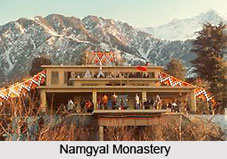
Monasteries in Northern India
 Monasteries of Northern India include the Buddhist monasteries of Ladakh, Leh, Himachal Pradesh, Sikkim and Arunachal Pradesh. Some of the Buddhist monasteries like
Key Monastery
Key Monastery or Key Gompa is a Tibetan Buddhist monastery located on top of a hill at an altitude of 4,166 metres above sea level. Key Monastery or Key Gompa is located very close to the Spiti River, in the Spiti Valley of Himachal Pradesh. Key Monastery or Key Gompa is the biggest monastery of Spiti Valley and a religious training centre for Lamas. It reportedly had 100 monks in 1855. Key Monastery or Key Gompa is also famous for the Buddhist pilgrims to meditate. One can find perfect peace and solace while entering in the Key monastery.
 Tangyud Monastery
Tangyud Monastery or Sa-skya-gong-mig Gompa at Hikim, is located in the Spiti valley of Himachal Pradesh. Tangyud Monastery is built like a fortified castle on the edge of a deep canyon, with massive slanted mud walls and battlements with vertical red ochre and white vertical stripes which make them look much taller than they really are. Tangyud Monastery has an altitude of 4,587 metres (15,049 ft), on the edge of a deep canyon and overlooking the town of Kaza in the Spiti District, which is 4 km from the town. Tangyud Monastery is located on the periphery of the Kibber Wildlife Sanctuary.
Shashur Monastery
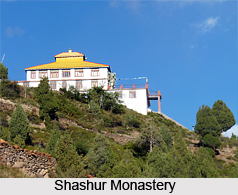
Shashur Monastery was founded in the 17th century AD. Lama Deva Tyatsho of Zanskar is the founder of the monastery. It is located a little distance away from Keylong in the state of Himachal Pradesh. Lama Deva Tyatsho was actually a missionary of the King of Bhutan. Deva Gyatsho carried out the work of renovation and gave it the present structure. The attractions of the monastery, which belongs to the Red sect of the Tibetan Buddhist, are the 15-feet `Thankha` and precious wall paintings presenting all the siddhas of Buddhism. In the month of June-July, during the Chham celebration, the lamas of the monastery celebrate the devil dance.
 Dhankar Monastery
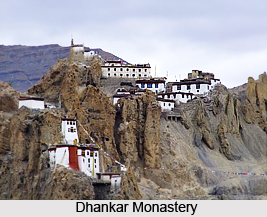
In the beautiful Spiti Valley of Himachal Pradesh is located the Dhankar Monastery. The monastery exhibits an image of `Vairocana` or Dhayan Buddha consisting of four complete figures seated back to back. It also has Buddhist scriptures in Bhoti language and relics in the shape of paintings and sculptures as its belongings. Other than these, there are two Gompas housed in the monastery. Those are Lha Opa Gompa and Lkhang Gompa. The Lha Opa Gompa is supposed to date back to 12th century. The second Gompa represent the life of Buddha in its splendid murals.
Khardong Monastery
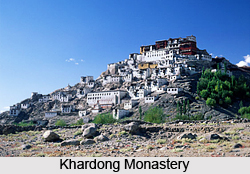
Khardong Monastery is a medieval monastery, placed 5km from Keylong, in Lahul and Spiti district, Himachal Pradesh. The monastery is located on the left bank of the Bhaga River in Khardong Village, at an elevation of 3500m above the surface level. Constructed in the 12th century, Khardong Monastery is renowned as an archetypal Lahul and Spiti architectural wonder. The gompa houses an immense library, containing the Kangyur and Tangyur volumes of Buddhist scriptures in Bhoti style, erstwhile weapons and a vast collection of intricate and finespun Thangka paintings and musical instruments including lutes, drums and horns. Khardong Monastery sports the maximum strength of monks and nuns in the Lahul region. The gompa can be reached by bus from Keylong.
 Alchi Monastery
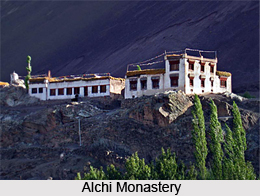
Alchi gompa is located on the banks of the Indus River, 70km from Leh and was constructed almost 1000 years back. One of its walls boasts thousands of miniature paintings of Lord Budha. The prime attraction of the gompa is however the three large sized images housed in the interior. Alchi is no longer an active religious institution and is looked after by monks of the Likir Monastery.
Some of the monasteries like Diskit Monastery, Dubdi Monastery, Gonjang Monastery, Pemayangtse Monastery, Sanga Choeling Monastery, Enchey Monastery, Gandhola Monastery and many other
Monasteries in East India
 The East Indian cities and towns of Gangtok, Darjeeling, Bomdila, Tawang, Bodh Gaya and Nalanda are cradles of Buddhism and Tibetan Buddhism and the many Gompas standing at these sites are a strong and vibrant reflection of the same, along with being a major factor promoting and boosting tourism in these places. The state of Sikkim and the hill station Darjeeling together alone house over 200 Buddhist monasteries.
Monasteries of North East India
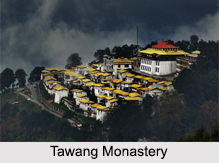
The monasteries in North East India are mainly found in the state of Arunachal Pradesh. Tawang Monastery located in Tawang town of the state is the largest monastery in India and second largest in the world after Potala Palace in Lhasa, Tibet. It is an important abode of Mahanaya Buddhism, following the Gelug school. Bomdila Monastery is another revered monastery following Mahanaya Buddhism. Other significant monasteries in the state are Rigyalling Monastery, Urgelling Monastery and Taktsang Gompa.
Monasteries in Darjeeling, West Bengal
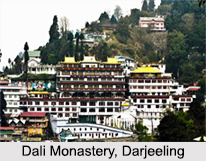
 Amongst the multiple monasteries established in the tourist destination Darjeeling, the prominent ones include the Ghoom Monastery, Bhutia Busty Monastery, Dali Monastery and Makdhog Monastery.
Monasteries in Sikkim
The organic state of Sikkim has a plethora of Gompas, mostly belonging to Nyingma and Kagyu lineages of Tibetan Buddhism. These include Pemayangtse Monastery at Gyalshing, 140 kilometres from Gangtok, Rumtek Dharma Chakra Centre in Rumtek, 24 kilometres from Gangtok, the hilltop Enchey Monastery, Dubdi Monastery near Yuksum, Tashiding Monastery about 40 kilometres from Gyalshing and Sinon Monastery about 10 kilometres from Tashiding village.
Monasteries in Nalanda
Excavations in the archaeological site of Nalanda, Bihar, have also revealed monasteries that were popular from the Gupta era to the Pala era. The ancient town of Nalanda was an important seat of Buddhism and the monasteries, presently in ruins, are scattered to the east of the main temple and on a higher level. There are remains of two monasteries having their entrances to the north and facing a brick-paved court. The buildings are provided on all four sides with small monk cells each having an entrance facing the concrete-paved balcony, the roof of which was supported by pillars. The shrine chamber of each of the monasteries is situated in the middle of the south row of cells, facing the entrance gate.
Vikramasila Monastery, Bhagalpur, Bihar
Excavations at the village of Antichak in Bhagalpur city of Bihar have exposed a Chaitya complex with two terraces entirely complete with terracotta panels, containing various tantric symbols. The Chaitya may have been the central site of ancient learning. It is surrounded by cells on all sides. These remains have been identified as those of Vikramasila-Mahavihara, a center for advanced studies in Buddhism.
Monasteries of North Eastern India
 Monasteries of North Eastern India consist of the monasteries like Bomdila Monastery, Rigyalling Monastery, Tawang Monastery, Urgelling Monastery, Tashiding Monastery, Phensang Monastery, Khartok Monastery, Tsuk- La- Khang Monastery and many other monasteries. North East India is a dwelling to a large number of monasteries. These monasteries not only show the present setting of religion in these states but also throw light on its earliest traditions and rituals.
Different Monasteries of North Eastern India
There are number of monasteries which are situated in North Eastern India and these are as follows:
Tashiding Monastery: It is said that Guru Padmasambhava shot an arrow in the air so as to select the place for his meditation. The site where the arrow stroked became the place of Tashiding Monastery.
Ghoom Monastery: The Ghoom Monastery is an extremely sacred place to the locales. The monastery follows the Gelug school of Tibetan Buddhism and there is a 15-feet high statue of "Maitreya Buddha" in the monastery. It contains images of Buddha"s disciples, Chenrezi and Chongapa.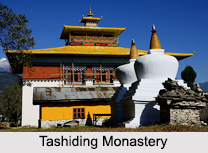
Enchey Gompa: It is believed that Lama Druptab Karpo constructed a little hut on this site, where he landed after his arrival from Maenam Hill. The present structure of the monastery was constructed in the shape of Chinese Pagoda.
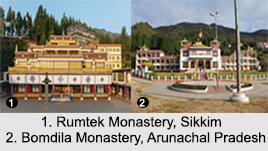
Rumtek Gompa: Rumtek Monastery also called the Dharmachakra Centre and it is a gompa situated in the Indian state of Sikkim.
Tawang Monastery: It is the largest monastery in India and second largest in the world. Tawang Monastery is situated in Tawang city of Tawang district in the Indian state of Arunachal Pradesh.
Ralong Monastery: It is situated in Sikkim. The celebration called Pang Lhabsol is celebrated here by monks, yearly. The monks perform the Kagyed dance, to express their happiness, on the eve of festival.
Pemayangtse Monastery: The Pemayangtse Monastery is a Buddhist monastery in Pemayangtse, situated near Pelling in the north eastern Indian state of Sikkim. The monastery was built for "pure monks" meaning "monks of pure Tibetan lineage", celibate and without any physical defect.
Bomdila Monastery: "Bomdila Monastery" is situated in west Kameng district of Arunachal Pradesh. The monastery was set up by the 12th reincarnation of Guru Rinpoche in 1965 and was further blessed by His Holiness, the 14th Dalai Lama in the year 1997.
Rigyalling Monastery: Rigyalling Monastery is located in the district of Tawang in Arunachal Pradesh. Rigyalling Monastery is one of the best centres for learning of Buddhism. This monastery has a renowned place among the different other Buddhist sacred places.
Phensang Monastry: Phensang Monastery follows the Nyingmapa order in Sikkim. Situated 9 kms north of Gangtok it was established in 1721 during the time of Jigme Pawo. Phensang Monastery is one of the major monasteries which are situated on the gentle slopes that spread from Kabi to Phodong. Besides being a place of reverence this also served as the residence of the three monks.
Christian Monasteries in India
 Adoration Monastery of the Sisters of St.Clare located in Mangalore, Karnataka, Kurisumala Ashram which is a Cisterian Monastery based in the Southern Indian state of Kerala, Manjanikkara Dayara Monastery in the Pathanamthitta District in the southern portion of Kerala, Vallikkattu Dayara Monastery in Travancore
Hindu Monasteries in India
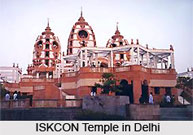
Indian monasteries of the Hindus are also known, as Dharmashala. Ashta Mathas of Udupi by Sri Madhvacharya and Sringeri Sharada Peetham in Sringeri are the two well-known Hindu monasteries in India. Advaita Ashramas, Belur Math, ISCON, Kanchi Matha and Kashi Mutt are also distinguished Indian monasteries serving the Hindu religion and its prophecies at its best.
The Indian monasteries are best places to attain peace of mind and spiritual realisation in a calm and tranquil environment. The patrons of religion dwell in these monasteries, thus promoting the tradition of self attained enlightenment in every form. The Indian monasteries have lately been discovered as beneficial tourist places too. Thousands of tourists visiting the Indian hill stations inevitably visit the Buddhists monasteries, while the passionate Hindus frequently visit the Hindu monasteries of India.