Introduction
Traditional Dresses of Odisha reflects the ancient culture of the state. Odisha has a rich ancient history as the land has been ruled by several dynasties. Kalinga, an ancient city in Odisha was the place that led to transforms the entire life of Samrat Ashoka changing his attitude towards spirituality through Buddhism. In Odisha, people take interest to preserve their tradition and culture. It is evident in many ways such as their food, clothing, the way they celebrate their festivals or the way they preserve their art through dance and music.

Traditional Attire of Odisha
The traditional clothes in Odisha for men are Dhoti and Kurta, whereas women prefer to wear Saree. Many varieties of sarees made by Handlooms of Odisha are widely available at different places of Odisha. Sambalpuri Pata Saree, Maniabandha Saree, Puri Patachitra Saree, etc are the popular sarees produced in Odisha. Along with traditional clothes, modern western clothes are also preferred by Odiya people in the current scenario.
Costumes for Women in Odisha
In Odisha, women wear different types of sarees. Famous sarees include Kataki Saree, Bomkai Saree and Sambalpuri Saree, though western attire has increasingly gained popularity among younger women in urban and semi-urban areas. These are adorned by females in Odisha during festivals, marriage and other special events. Salwar Kameez is also worn by the girls and women. They like to beautify themselves with a lot of jewelleries and ornaments.
Sarees of Odisha:
The sarees of Odisha enjoy strong demand not only within the
state but also across the world, admired for their craftsmanship, vibrant
colours, and cultural significance. The wide range of hues and styles available
in Odia sarees contributes greatly to their appeal among women. Odisha’s
handloom sarees are broadly categorized into four major types: Sambalpuri
Kapta, Sambalpuri Bandha, Sambalpuri Bomkai, and Sambalpuri Saptaper. Each
variety reflects distinct weaving traditions and aesthetic expressions rooted
in regional heritage. A defining feature of these sarees is the tie-and-dye
technique employed by Odishan weavers to create intricate motifs.
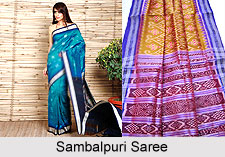
Sambalpuri Saree: The Sambalpuri saree is widely regarded as one of Odisha’s most iconic traditional garments. Crafted using the Ikat technique, these sarees are produced by tie-dyeing the yarns before weaving, a meticulous process that results in intricate and well-defined patterns. They are commonly made from cotton or silk and are often referred to as Sambalpuri silk sarees when woven in silk. Characterized by their geometric designs, Sambalpuri sarees frequently incorporate traditional motifs such as wheels, flowers, and shells. Their vibrant colours and striking contrasting borders further enhance their visual appeal.
Kataki Saree: Another well-known saree from Odisha is the Kataki saree, which originates from the city of Cuttack. These sarees are distinguished by their intricate craftsmanship and the rich use of silver and gold zari work. Typically woven from fine natural fibres such as cotton or silk, Kataki sarees reflect both elegance and durability. The designs featured on Kataki sarees draw inspiration from a wide range of sources, including temple architecture, animals, floral patterns, and other traditional motifs.
Pasapalli Saree: The Pasapalli saree, also crafted using the Ikat technique, derives its name from its distinctive pattern that resembles the squares of a chessboard, with pasa meaning dice in the Odia language. These sarees are characterized by alternating squares in contrasting colours, most commonly combinations such as black and white or red and white. Intricately designed borders further enhance the visual appeal, giving the Pasapalli saree a bold and recognizable identity within Odisha’s textile tradition.
Khandua Saree: The Khandua saree is a traditional handwoven silk saree that holds particular prominence in the temple town of Puri. Also known as Kenduli Khandua, it takes its name from Kenduli village and carries strong religious and cultural associations. The saree is often worn by temple priests or offered to Lord Jagannath as part of ritual practices. Woven from fine silk yarns, Khandua sarees are celebrated for their refined craftsmanship and symbolic designs. Common motifs include elephants, lotus flowers, and inscriptions rendered in ancient Odia script.
Bomkai Saree: The Bomkai saree, also known as the Sonepuri saree, is another prominent traditional saree from Odisha, originating in the Ganjam district. This textile form is distinguished by its unique fusion of traditional tribal art with refined Ikat weaving techniques. Bomkai sarees are produced in cotton for everyday wear and in silk for ceremonial and special occasions. Their designs frequently feature tribal-inspired motifs such as birds, fish, and floral patterns, complemented by intricately woven borders in contrasting colours.
Pattachitra Saree: Pattachitra is a traditional painting style native to Odisha, and over time, this art form has been seamlessly adapted into textile traditions, particularly sarees. Pattachitra sarees are distinguished by their hand-painted surfaces, which showcase mythological narratives and motifs inspired by the state’s renowned temple art. These sarees often depict scenes from the Mahabharata and the Ramayana, along with visual representations of Lord Jagannath, Lord Krishna, and other Hindu deities.
Dupatta or Uttariyo: The dupatta holds an important
place in traditional attire, and an ensemble is often considered incomplete
without it. Another essential element of an Odia bride’s dress is the uttariyo,
a large piece of fabric used to cover the head. This cloth is noted for its
delicate beauty, enhanced by intricate zari embroidery. The overall bridal
attire is further elevated by the addition of a matching headpiece, creating a
cohesive and visually striking appearance.
Costumes for Men in Odisha
Similar to females, men also like to wear their traditional
outfits. Generally, Dhoti is the common traditional costumes for men in Odisha.
They also wear dhoti, Kurta and Gamucha during the festival and other
traditional celebrations. The head of the family follows their religious
costume strictly so that others also stay in touch with their culture and wear
their traditional costumes.

Dhoti: The dhoti is the most common form of traditional attire worn by men in Odisha, much like in other parts of India. It consists of a long piece of cloth, typically white or cream in colour, which is wrapped around the waist and legs in a simple yet functional manner.
Kurta: Often paired with the dhoti, the kurta is a long, loose-fitting shirt worn by men. It may be simple in design or embellished with embroidery, depending on the occasion and personal preference.
Gamucha: A gamucha, or shawl-like piece of cloth, is commonly used as an accessory and is often draped over the shoulder or wrapped around the head as a turban.
Khandua Pata: The silk Khandua is traditionally worn by men, particularly priests or during special occasions, and is draped in a manner similar to a dhoti.
Though, the western culture has influenced a lot in Odisha
that can be seen in the clothing of youngsters, the traditional outfits still
live in the heart of native inhabitants. They ensure that at least in their
festivals like Durga Puja, they wear the cultural outfits.
Tribal Costumes in Odisha
Odisha possesses a rich cultural and social history and is
widely recognized as home to more than 60 indigenous tribes.
Each of these communities carries forward distinct traditions, reflected
vividly in their conventional attire. Tribal costumes across the state are
closely tied to local resources, ancestral practices, and social identity,
making Odisha’s textile heritage both diverse and deeply symbolic. Among the
many tribal garments, some of the most distinctive include the Ringa of the Bonda
tribe, the Kapda Ganda of the Dongria Kandha tribe, the Phuta sarees worn by
the Santhals, and the Gatungcab of the Lanjia Saora community.

Bonda tribe: The Bonda tribe, largely residing in the Malkangiri district, is particularly known for its traditional clothing woven from kerang fibre. The Ringa, also referred to as Nandik, is a small piece of cloth worn by Bonda women around the pelvic area and remains one of the most recognizable symbols of the tribe, setting them apart from other indigenous groups in Odisha.
Gadaba tribe: The Gadaba tribe, another prominent ethnic community in the region, is known for its striking cultural markers. Women of the Gadaba tribe wear heavy neck rings weighing between 500 and 800 grams, which are traditionally worn for life. Their customary attire consists of a two-piece dress made from kerang fibre, tanned using vegetable dyes. Striped patterns are a common feature of these garments, reflecting both aesthetic sensibility and traditional craftsmanship.
Dongria Kandha tribe: The Dongria Kandha tribe is celebrated for the Kapda Ganda, an elegantly woven and intricately embroidered shawl. Created primarily by Dongria women, this textile holds emotional significance, as it is traditionally designed to express affection and love for their partners. The garment is not merely decorative but also serves as a personal and cultural expression.
Santhal tribe: The Santhals, spread across the districts of Mayurbhanj, Keonjhar, and Balasore, also maintain a distinctive style of dress. Santhal men typically wear simple white dhotis, while women adorn themselves in sarees known as Phuta or Phoda. These handwoven organic tussar sarees are extremely lightweight and feature ancestral themes along with tribal and nature-inspired motifs. Traditionally, the sarees are worn just below the knees.
Saora tribe: The Saoras, an ancient ethnic community belonging to the Munda group and among the earliest settlers in Odisha, have their own unique attire. Saora women traditionally wear a midsection cloth that extends just above the knees, reflecting simplicity and continuity with their long-established way of life. Together, these traditional costumes offer a compelling glimpse into the cultural richness and living heritage of Odisha’s tribal communities.
Traditional Jewellery of Odisha
Shaped by a long and layered history and the strong influence of indigenous communities, the region is rich in traditional tribal jewellery crafted from silver, brass, shells, beads, and other natural materials. These adornments include nose pins, heavy and chunky bangles, and elaborate necklaces, all of which form an integral part of cultural expression.
Such pieces are far more than decorative accessories. Each item carries symbolic meaning and social significance. Coin necklaces, for instance, are traditionally worn as markers of wealth and prosperity, while women of the Kondh tribe wear nose pins as a protective measure believed to ward off evil influences.
Among the most renowned yet endangered forms of jewellery is Tarakashi. This intricate craft, executed primarily in silver, involves heating thin silver sheets, carefully beating them, and folding them into delicate, ornate patterns. Dating back nearly 500 years, Tarakashi represents an ancient form of handwork known as filigree and stands as a reflection to the region’s exceptional artisanal heritage.