Introduction
 Alwar captivates the mind of any tourist willing to see the gorgeous beauty of Alwar Fort and the Hill fort, the glorious history of Rajputs and the wildlife sanctuaries.
Location of Alwar
Alwar is situated about 150 km from south of Delhi, the capital city of India and about 150 km north of Jaipur, the capital city of Rajasthan. Alwar is now also an integral part of National Capital Region (NCR).
History of Alwar
The history of Alwar traces back from 1000 AD, with the advent of kingdom of Amer. Later it came under the suzerainty of Delhi Sultanate and Mughal Dynasty. The Princely State of Alwar was founded by Pratap Singh in the second half of the 18th century. After the Independence of India in 1947, this Princely State was merged with Government of India.
Geography of Alwar
The latitudinal and longitudinal limit of Alwar in Alwar District is about 27.57 degree north to 76.6 degree east. The average elevation of Alwar is about 271 meters. Ruparail River is the major lifeline of Alwar.
Demography of Alwar
According to the Population Census in the year 2011, Alwar had the average population of about 1,015,310. It is considered the busiest city in Rajasthan. Yadavas, Ahirs, Rajputs, Jats and Meo are the residents in the Alwar.
Culture of Alwar
Alwar is known for its cuisine and festivals. The festivals celebrated in Alwar are Alwar festival, Teej, Chuhar Sidh, Laldas Maila, Bilali Fair, Sahibji ka Maila and Jagannath Fair Alwar is also famous for Kalakand (sweet dish), which is widely known as Milk Cake.
Economy of Alwar
The economy of Alwar is reflected with the industries based in outskirts of Delhi. Alwar is based on agriculture. Alwar also produce crops like Jowar, Millet, Cotton, Wheat and Mustard.
Travel Information on Alwar
 Travel Information on Alwar will help the travelers to know the district better before they set out on their trips. Most of the tourists are attracted to this district because of its proximity to the Sariska National Park. However Alwar itself has been an important historic place in ancient India. It was once upon a time the capital of the princely states. From Jaipur and Delhi it is accessible by road. From Jaipur it is located at a distance of 150 kilometers and from Delhi it is 170 kilometers away.
Flights are also available from Delhi to arrive at Alwar. It is the nearest airport to the district situated at a distance of 163 kilometers. The railways are a favorable option to travel too. Trains like Mandore Express, Shatabdi Express and others are available for Alwar. These trains run ply from Jodhpur, Ajmer, Delhi and Jaipur. Besides Delhi this historic district is also well connected by road to other cities of Rajasthan. The nearest district of Alwar is Bharatpur. The latter is well known for its bird sanctuary.
The accommodations in Alwar are varied. All kinds of travelers will be able to find out the appropriate hotel for themselves. Heritage hotels, deluxe hotels and economy hotels are widely scattered throughout the district. The location and the services of these hotels are par excellence. Neemrana Fort Palace Hotel and Hill Fort are some of the hotels.
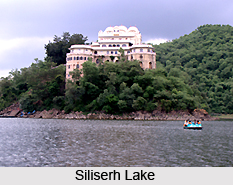
The sightseeing in Alwar comprise of Bala Fort, City Palace, Government museums, Siliserh lake, Sariska National Park and the town of Deeg. Temples are also scattered within and around the district. The best season to visit Alwar is from September to February. As it is located near a desert region it is better to carry light summer apparels while touring the district. However in case the tourists are planning for a holiday during the winter light woolen clothes will be required.
English is widely understood and spoken as well. Hence the travelers will not face any problem in communicating. Since it is a popular tourist center all kinds of cuisines are available. The travelers can check out the curio shops and handicrafts in Alwar, Rajasthan.
Places of Interest in Alwar
 The places of interest in Alwar mainly introduce one to the history and culture of the district. Forts, palaces, temples and lakes are the predominant structures here. These ancient buildings add to the beauty of the quaint region.
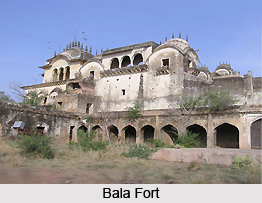
Bala Fort: This is a massive structure that dates back to 928 AD. It has 15 large and 51 small towers and 446 openings for musketry. The fort also houses 8 huge towers all around it. These towers were constructed for the fort`s protection. The main entrance of the fort is Jai Pol. this entrance is located at a distance of almost10 kilometers from the city centre. Presently, however the fort is in state of ruins. Historically it is still significant because of its turbulent past that depicts the resistance of the Mughals, the Pathans, the Jats, the Marathas before finally being conquered by Raja Pratap Singh in 1775.
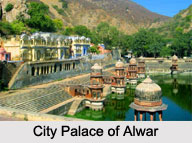
City Palace in Alwar: Created by Raja Bakhtawar Singh in 1793 the city palace houses some rare and ancient manuscripts, such as, an illustrated copy of Mahabharata, Gulistan (the Garden of Roses), Boston (the Garden of Spring) and Waquate-e-Baburi (Autobiography of the Emperor Babur). These manuscripts are in variety of languages like Sanskrit, Persian, Urdu and others. The building is intricately designed and offers a comprehensive insight into the lifestyle of the Rajputs. There are various other heirlooms from the Maharaja`s collection, a silver dining table and some miniature models
Within the proximity of the city palace lies a large tank, Sagar and towards its right a chhatri of Raja Bakhtawar Singh is situated. A picturesque garden is also located nearby and this too is one of the popular places of interest in Alwar.
Neemrana: This was once a fort of the Rajputs. Today it has been converted to a heritage hotel. It is considered one of the oldest heritage hotels in India.
Historical Monuments of Alwar
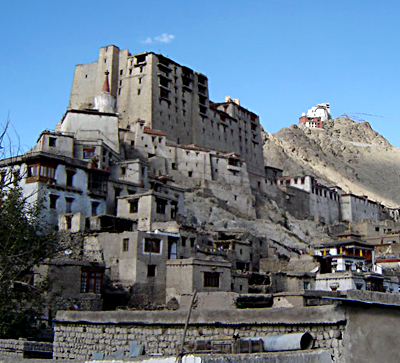
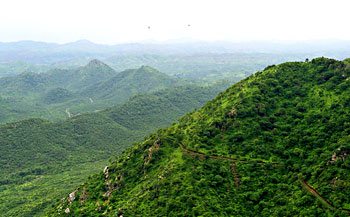 Alwar abounds in historical monuments found here in the form of a number of forts and palaces. For instance, the Alwar fort is stands regal and tall at 1000 feet above the city of Alwar. It was built by Hasan Khan Mewati in 1550 AD. It went on to later change hands between the rulers of the Mughal dynasty, the Marathas and the Jats till it was finally captured by the Kachhwaha Rajputs. The fort is about 1.5 kms wide and runs from North to south in a 5 km long stretch. There are a total of six entrances to the fort. To the west is Chand Pol, east is Suraj Pol and south Lakshman Pol. The fourth and fifth gates arc known as Jai Pol and Kishan Pol, while the sixth, in the north, is Andheri Pol. Within the fort lie the remains of the Nikumbh Mahal, ten pools and the remains of fifteen temples. It is said that the founder of Alwar, Pratap Singh, used Laxman Pol for entering the fort for the first time. In the past, the city was connected by means of a metalled road with Laxman Pol. The fortifications extend 3-2 km (2 miles) along the hilltop, beneath which lie two outworks, the Chitanki and Kabul Khurd.
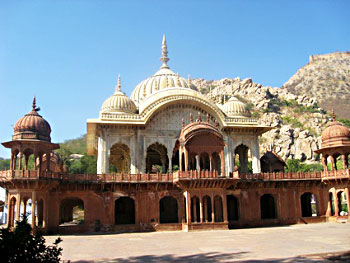
Below the scarred battlements of the fort, at the base of the hill across which it sprawls, is the City Palace with its spacious apartments. An exquisite pond called Sagar is situated behind the City Palace.
The City Palace is an eighteenth century palace which displays a harmonious blend of Rajput and Mughal styles of architecture. Its construction was started in 1793 by Rajah Bakhtawar Singh. The Palace consists of a varied group of buildings of different styles facing a large ornamental tank. Fifteen imposing towers and 51 smaller towers overlook the mountain slopes. Moreover, the palace has 446 openings for musketry. There is a central courtyard which has a lotus flower base constructed in marble. It is said to have been occupied by great Mughal Emperors like Babur and Jahangir at different points in time. The interior is notable for the Mirror Room, which overlooks the tank, the Library, which contains a fine collection of Oriental manuscripts, including a copy of a beautifully illustrated `Gulistan` manuscript from 1848, and the Armoury, with a rich collection of bejewelled sabres, swords and weapons. One of the most famous artefacts found here is an emerald cup whose value is priceless. The New Court dates from circa 1850. The Palace is now functioning as the office of the district collectorate.
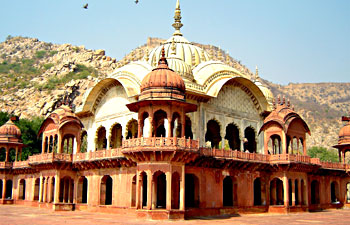
The Vijay Mandir Palace is a beautiful architectural work. It was built by Maharajah Jai Singh in 1918 AD. There is a fabulous Sita Ram temple contained in the Palace attracts a number of devotees, especially during Ramnavami. A lake overlooking the palace provides a rather picturesque sight. Currently, the ground floor of the palace has been converted into government offices and district courts, while the upper floor houses a museum.
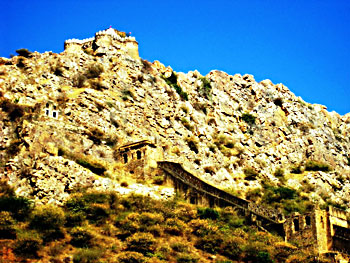 The Neemrana fort was a stronghold of the Chauhan dynasty, and is situated in a horseshoe shaped cleft in the Aravalli hills. The fort was built and renovated over different periods of time in history. It has recently been restored and is now a heritage hotel.
The Cenotaph of Maharaja Bakhtawar Singh lies to the Southside of the Sagar. It has been marble enriched with Bengali arches on a red sandstone podium. The monument is surrounded by hundreds of peacocks and colourful birds. To the right of the main entrance of the palace is the house of the elephant carriage, which contains a two-storey processional car built to carry over fifty people drawn by four elephants.
The Moosi Rani ki Chhatri is a magnificent construction. It was built in memory of the wife of Maharajah Bakhtwar Singh. It is a double storied structure with intricate marble carvings which took nine years to complete.
The Government museum at the top floor of the City Palace complex has a unique collection of exhibits of the Maharajahs of Alwar and other historic personalities. These include royal vestments in beautiful brocades, Kashmiri lacquer work, stuffed animals, stone sculptures, such as an 11th century sculpture of Lord Vishnu and even some historic swords belonging to the likes of emperors Akbar and Aurangzeb of the Mughal dynasty and Sultan Muhammad Ghori.