Introduction
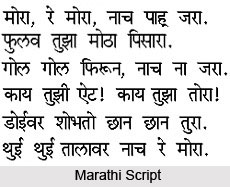 Marathi is an Indo Aryan language spoken by the Marathi people of western India (Maharshtrians). It serves as the official language of the state of Maharashtra, with roughly ninety million fluent speakers in Marathi language worldwide. Marathi ranks 4th in India with respect to the number of people who claim it as their primary language. Along with Bengali, Marathi is the oldest of the regional literatures in Indo-Aryan languages, dating from about 1000 AD. Marathi is at least fifteen hundred years old, and derives its grammar and syntax from Pali and Prakrit. The Marathi language was earlier known as Maharashtri, Maharathi, Malhatee or Marthi in ancient times. Some of the peculiar features of Marathi linguistic culture include Marathi drama, with its unique style of `Sangeet Natak`, scholarly discourses called `Vasant Vyakhyanmala`, Marathi folk dance called `Lavani`, and special editions of magazines for Diwali called `Diwali anka`.
History of Marathi Language
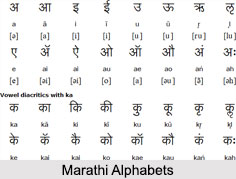 Marathi is an Indo Aryan language spoken by the Marathi people of western India (Maharshtrians). It serves as the official language of Maharashtra. Marathi language was earlier known as Maharashtri, Maharathi, Malhatee or Marthi in ancient times. Marathi is supposed to be more than 1300 years old, having evolved from Sanskrit, which eventually was derived from Prakrit and Apabhramsha. Its grammar and syntax are said to have originated from Pali and Prakrit.
Literary Works in Marathi Language : Marathi has a long literary tradition where the literary works of the saint and poet Dnyaneshwar, are very popular. Other famous saint-poets include Eknath, Tukaram and Namdev, who were instrumental in enriching the Marathi language. Thus, Marathi is said to have the richest saint-literature of all Indian languages. The first Marathi text was written in the 11th century as inscriptions on stones and copper plates. From the 13th to the mid 20th century, it was written in the Modi alphabet and since 1950, it is being written in the Devanagiri alphabet.
Use of Marathi Language : After 1187 CE, the use of Marathi grew substantially in the inscriptions of the Seuna (Yadava) kings, who earlier used Kannada and Sanskrit language in their inscriptions. Marathi was widely used during the Sultanate period as well. Although the rulers were Muslims, the local landlords and the revenue collectors were Hindus and so was the majority of the population. Hence, to simplify the administration and revenue collection, the sultans promoted the use of Marathi in official documents. Marathi also became the language of administration during the Ahmadnagar Sultanate and Adilshahi Sultanate of Bijapur.
Persian Influence in Marathi Language : Marathi language has a huge influence of Persian language. Several Persian words have been derived in Marathi language like bag (Garden), karkhana (factory), shahar (city), bazar (market), dukan (shop), hushar (clever), kagaj (paper), khursi (chair), jamin (land), jahirat (advertisement), and hazar (thousand) etc.
Marathi Language during Maratha Empire : Marathi gained prominence with the rise of the Maratha Empire beginning with the reign of Chhatrapati Shivaji Maharaj. Under Shivaji, the language became less Persianised also. This period also saw the use of Marathi language in transactions of land and other business as well. Thus, documents from this period give a better picture of the life of common people. There are a lot of Bakharis written in Marathi and Modi script from this period.
Marathi Language during British Rule : The British colonial period starting in early 1800s saw standardisation of Marathi grammar through the efforts of the Christian missionary William Carey. Translations of the Bible were first books to be printed in Marathi. These translations by William Carey, the American Marathi mission and the Scottish missionaries led to the development of Marathi, which is called the "Missionary Marathi" in early 1800s.
Evolution of Marathi language
The Marathi language, with a history spanning over 2500 years, has undergone significant transformations mirroring the changes in society. The language has experienced several distinct phases, each leaving its mark on the linguistic and literary landscape.
The Early Period (1200 BC - 1250 AD): The language`s earliest written records can be traced back to this period when works like "Leela Charitra" and "Dnyaneshwari" emerged. Marathi words and phrases of this era found mention in copper plates and inscriptions.
The Yadavakal (1250 - 1350 AD): During the rule of the Yadavas of Devagiri, Marathi gained prominence as the royal language. The period witnessed a flourishing of literature, and the emergence of Mahanubhava cult and the Varkari sect played a significant role in enriching Marathi literature with devotional poetry.
Bahmani and Sultanate Period (1350 - 1600 AD): With the Muslim rule commencing, Marathi continued to be widely used, especially in administration and record-keeping under the encouragement of local Hindu feudal lords and the majority population. The language saw the influence of Persian words, yet notable figures like Narsimha Saraswati and Eknath contributed to the literary legacy.
The Maratha Empire (1650 - 1818 AD): During the Maratha Swarajya, the Persian influence on Marathi diminished. Sant Tukaram and Samarth Ramdas Swami played pivotal roles in elevating Marathi to public recognition alongside its royal recognition. New literary genres like lavani and powada emerged, and society acknowledged literature as a form of entertainment. Moropant and Sridhar were prominent poets of this era.
The English Period (1818 - Present): This period marked the rise of prose writing and the spread of Marathi language due to the introduction of printing. The language underwent punctuation standardization by Major Kandy, simplifying Marathi writing. Savarkar`s language purification movement led to the creation of many new Marathi words that are popular even today.
Post-Independence Period: After India`s independence, the language underwent further development and purification. Savarkar`s efforts led to the creation of essential Marathi words, catering to the modern era`s needs. The literary landscape saw diverse movements, including the `Chabildas` and `Dalit Panthers,` leaving a profound impact on Marathi literature.
Modern Times: The later part of the 20th century witnessed the rise of influential literary figures like Gashiram Kotwal, Sakharam Binder, and Gidhade, as well as the women`s liberation movement, which introduced new perspectives in literature.
 Marathi Literature
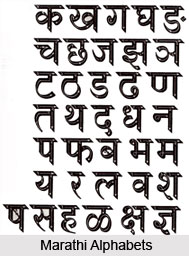
Marathi literature boasts a rich and diverse collection of renowned works, contributed by prominent Maratha literary personalities. The period of the Maratha Empire witnessed the creation of masterpieces like "Ghadalay Bighadalay" by Moropant and "Harivijay" and "Pandava Pratap" by Sridhar, which explored themes of valor and heroism. Sant Tukaram`s "Abhanga Gatha" and Samarth Ramdas Swami`s "Dasbodh" are revered for their spiritual depth and profound teachings. The later era saw the emergence of trailblazing works like "Gashiram Kotwal" by Vijay Tendulkar and "Katyar Kaljat Ghusli" by Purushottam Darvhekar, both contributing significantly to Marathi theater. These timeless literary gems continue to inspire generations, reflecting the language`s cultural and artistic richness.
Dialects of Marathi language
The major Marathi dialect divisions have been:
Ahirani : Ahirani is spoken in the west Khandesh, North Maharashtara region. Ahirani is a language today spoken in the Jalgaon, Nandurbar, Dhule and Nashik (Baglan, Malegaon and Kalwan tehsils) districts of Maharashtra, India. It is further divided into languages, such as Chalisgaon, Malegaon and Dhule group. Borrowing & bending the words from Hindi and Gujarati, Ahirani has created its own words which are never found in these languages. Ahirani is a colloquial form and uses the Devnagari script for its writing. Though it is the written form of devnagari but it is very difficult to write rather than to speak.
Khandeshi : Khandeshi is spoken in East Khandesh specifically in Yawal and Raver Talukas. Khandeshi is also called as Tawadi which is specifically spoken by Leva Patils dominant cast of east Khandesh. Bahinabai Chaudhari is well known poet in Khandeshi, the study of her literature is studied and included in Marathi language. It is often misquoted that Bahinabai is an ahirani poet.
Konkani : Although the constitution of India and Sahitya Academi considers Konkani as one of the 21 official languages, in Maharashtra Konkani is considered a dialect of Marathi. The Britannica Encyclopedia 1911 reported Konkani as only one real dialect of Marathi. Maharashtrians and Konkanis in Goa have had bitter fights over the official language issue. The Marathi-Konkani feud and inclusion of Konkani in scheduled languages was mostly because of political reasons and status as Konkani as a separate language is disputed. The claims of Dnyaneshwari being in Konkani and Marathi itself being a dialect of Konkani have not been proved. Marathi linguists and Maharashtrians in Goa and Maharashtra consider Konkani as a boli (dialect) of Marathi. Most Konkani people in Maharashtra speak and write fluent Marathi.
Wadvali : This language may not be named though, but was primarily spoken by Wadvals which essentially means agricultural plot owners, of the Naigaon, Vasai region . This language is preserved by Roman Catholics native to this region and is also spoken by the Hindus. But due to external influence ordinary Marathi is now more popular among the Hindus.
Samavedi : Samavedi is spoken in the interiors of Nala Sopara and Virar region to the north of Mumbai in the Vasai Taluka, Thane District of Maharashtra. The name of this language correctly suggests that its origins lie with the Samavedi Brahmins native to this region. Again this language too finds more speakers among the Roman Catholic converts native to this region who are known as East Indians. This language is very different from the other Marathi languages spoken in other regions of Maharashtra, but resembles Wadvali very closely. Both Wadvali and Samavedi have relatively higher proportion of words borrowed from Portuguese as compared to ordinary Marathi, because of direct influence of the Portuguese who colonized this region till 1739.
Thanjavur Marathi & Namdev Marathi : Thanjavur and Namdev Marathi is spoken by many Southern Indians. This language has evolved from the time of occupation of the Marathas in the Thanjavur in southern Tamil Nadu. It has speakers in parts of Tamil Nadu, Andhra Pradesh and Karnataka.
Others dialects: :
Dangii (spoken near the Maharashtra-Gujarat border)
Judaeo-Marathi (spoken by the Bene Israel Jews)
Malvani (spoken in southern Konkan near Malvan)
Kadodii (spoken near Vasai)
Marathi influence on other languages
Dakhini and Hyderabadi Urdu spoken in Hyderabad and some parts of Deccan are considerably influenced by Marathi. The grammar of Hyderabadi Urdu is loaned from Marathi. In fact, it is also called a creole between Marathi and Urdu with some Telugu loan words.
Kannada, especially the northern Karnataka, has been heavily influenced by Marathi. For instance, feature of aspiration quite non-native to any Dravidian language is found in northern Kannada. Also loan kinship terms like vahini (brother`s wife) etc. are also borrowed from Marathi.
Official Status of Marathi language
Marathi serves as an official language of Indian state of Maharashtra. The State of Goa also recognizes Marathi as an official language, in addition to Konkani. The Constitution of India recognizes Marathi as one of India`s twenty-two official languages. In addition to universities in Maharashtra, universities at Baroda (Gujarat), Osmania (Andhra Pradesh), and Panjim (Goa) all have special departments for higher studies in Marathi linguistics.
Geographic Distribution of Marathi Speakers
Marathi language finds its predominant usage in the state of Maharashtra, India. However, its influence extends beyond the borders of Maharashtra, reaching various regions within the country and even crossing international boundaries. Apart from Maharashtra and its neighboring state, Goa, Marathi is spoken in certain areas of North Karnataka, including Belgaum, Hubli-Dharwad, Gulbarga, Bidar, and Karwar. Additionally, it is prevalent in certain pockets of Gujarat, such as South Gujarat, Surat, Baroda, and Ahmedabad, and also in Andhra Pradesh, primarily in Hyderabad.
Marathi has also found its way to states like Madhya Pradesh, particularly in cities like Indore and Gwalior. Moreover, there is a presence of Marathi speakers in Tamil Nadu, mainly in Tanjavur. The linguistic footprint of Marathi extends to Chhattisgarh as well.
In addition to the Indian subcontinent, Marathi has traversed borders and taken root in several countries. Marathi speakers are found in nine Indian states, four Union Territories majorly in Daman and Diu, Dadra Nagar Haveli, and an impressive 113 countries worldwide. Marathi is spoken by Maharashtrian emigrants in USA and Europe. The Ethnologue states that Marathi is even spoken in Israel and Mauritius. This wide global spread of Marathi speakers signifies the language`s growing influence and presence on an international scale.